Dwarves
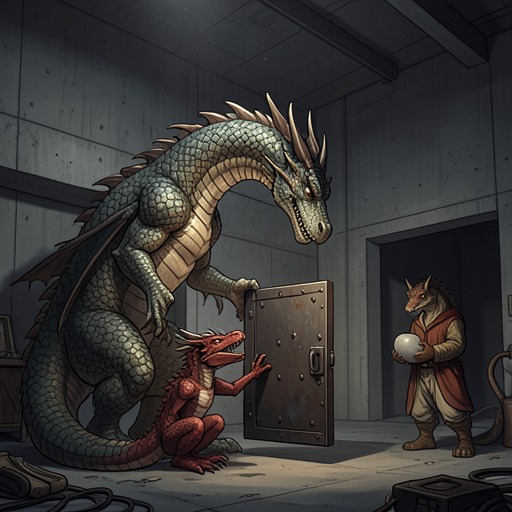
Vainqueur the DragonDwarves are presented as a sentient people caught between civilization and prey in the worldview of Vainqueur Knightsbane. They are not merely anonymous livestock: they possess cities, participate in the wider political geography of Outremonde, and are important enough to become the subject of a planned raid. Yet Vainqueur still evaluates them primarily through appetite, preciousness, and the practical risks of consumption. Their role therefore exposes the contradiction at the heart of the dragon’s food-chain ideology: intelligence and social organization do not necessarily protect a people from being classified as food.
Place in Vainqueur’s Food Chain
Vainqueur’s hierarchy ranks creatures according to preciousness and eating rights. He explains to Victor Dalton that members of the chain may eat those below them when hungry, and even describes minions as possible emergency rations. Within that system, Dwarves are treated as edible sentient beings rather than as equals. This logic is not confined to private appetite. Vainqueur also argues that exterminating the mortal races would be foolish because he needs them to supply coins and princesses, making the continued existence of other peoples useful to his hoard even when their lives remain morally secondary to him.
The dragon’s selective mercy makes the classification more revealing. When Jolie argues that eating manlings and abducting princesses is morally wrong, Vainqueur immediately exempts elves, while Victor Dalton points out that elves are people too. The exchange shows that Dwarves belong to a broader category of intelligent peoples whom Vainqueur can recognize as socially significant without granting them protection. Their status is governed less by a consistent principle than by dragon custom, preference, and appetite.
The Planned Raid and the Appetite of Dragons
After Jolie’s first Bragging Day, Genialissime proposes attacking a nearby Dwarf city with Blightswamp. The plan is framed as a continuation of dragonly feasting: even before the celebration has begun, the dragons are already discussing the feast that will follow it. Vainqueur is invited to join them because Dwarves are described as fat and tasty, but he remembers that eating them produces an unusual effect. He becomes drunk, loses his way home, and cannot reliably control what follows.
The proposed raid thus combines territorial aggression, predation, and convivial excess. A Dwarf city is not treated as a community with its own claims, but as a nearby supply of food and an opportunity for a dragon gathering. At the same time, the conversation gives Dwarves a peculiar power over their intended predator: their flesh affects Vainqueur’s body and judgment. The people marked as prey are consequently able to destabilize the hierarchy through the physical consequences of being eaten.
Intoxication, Violence, and the W-Word
The aftermath confirms that Vainqueur’s appetite is not harmlessly comic. He recalls becoming drunk on eating Dwarves, and Genialissime reports that he consumed three before losing control. Vainqueur then became violently irrational and burned everything around him. When Genialissime and Blightswamp tried to restrain him, he insulted Blightswamp by calling her a wyvern, an especially serious offense because she is a true dragon. The event turns Dwarves from a culinary preference into the cause of a social and physical crisis among dragons.
Vainqueur is horrified when the incident is recounted to him. His embarrassment centers on having misidentified a fellow dragon, but the larger consequence is that his own appetite has made him dangerous to allies and surroundings alike. Genialissime diagnoses the problem as a serious Dwarf intolerance. The phrase gives the episode a mock-medical conclusion while preserving its ethical edge: Vainqueur’s body rejects the prey he eagerly seeks, yet his judgment fails before that rejection can protect anyone.
Cities, Expansion, and the Limits of Appetite
Dwarves are associated with an established urban presence rather than an isolated band of wanderers. Genialissime specifically mentions a new Dwarf city near the dragons’ region, making it a visible feature of the frontier and a potential target of expansion. The city’s existence contrasts with the way Vainqueur imagines it: to him, its principal relevance is the food it contains and the possibility of a post-celebration attack. This gap between Dwarf settlement and dragon perception illustrates how conquest begins by reducing a place to resources.
The same narrative repeatedly links governance to food. Victor Dalton is ordered to turn discarded monster parts and corpses into money, and later organizes irrigation, canals, tree planting, and agricultural experimentation because Vainqueur’s celebrations require enormous quantities of meat. The scale is explicit: at least two hundred and fifty tons of meat are estimated for Bragging Day, equivalent to roughly two thousand five hundred well-fed sheep or four hundred cows per day. Against this background, the planned Dwarf raid is not an isolated joke but part of a wider economy in which populations, bodies, labor, and land are measured according to the demands of dragon consumption.
Consequence and Thematic Significance
After his disastrous intoxication, Vainqueur decides to migrate south toward the Albain Mountains, seeking a more populated area with food nearby while also choosing a high location that might deter thieves. He imagines the title of King of the Albain Mountain as a grand extension of his identity, but the immediate reason for the move is practical: his rampage has frightened food away for miles, leaving him with the problem of finding new sources of prey. The Dwarf episode therefore contributes directly to his territorial thinking, even though it does not make him more tolerant of the people he consumes.
His final resolution is blunt: Vainqueur promises never to eat Dwarves again. The promise functions as both a comic punchline and a rare limit imposed on his appetite by experience. It does not establish a general ban on eating sentient beings, challenge the food chain, or produce a new ethic of interspecies relations. Instead, it marks a narrow, self-interested boundary created by bodily intolerance, drunken violence, and shame. Dwarves are significant precisely because they reveal how far Vainqueur’s hierarchy can extend—and how abruptly it can fail when appetite turns against the eater.